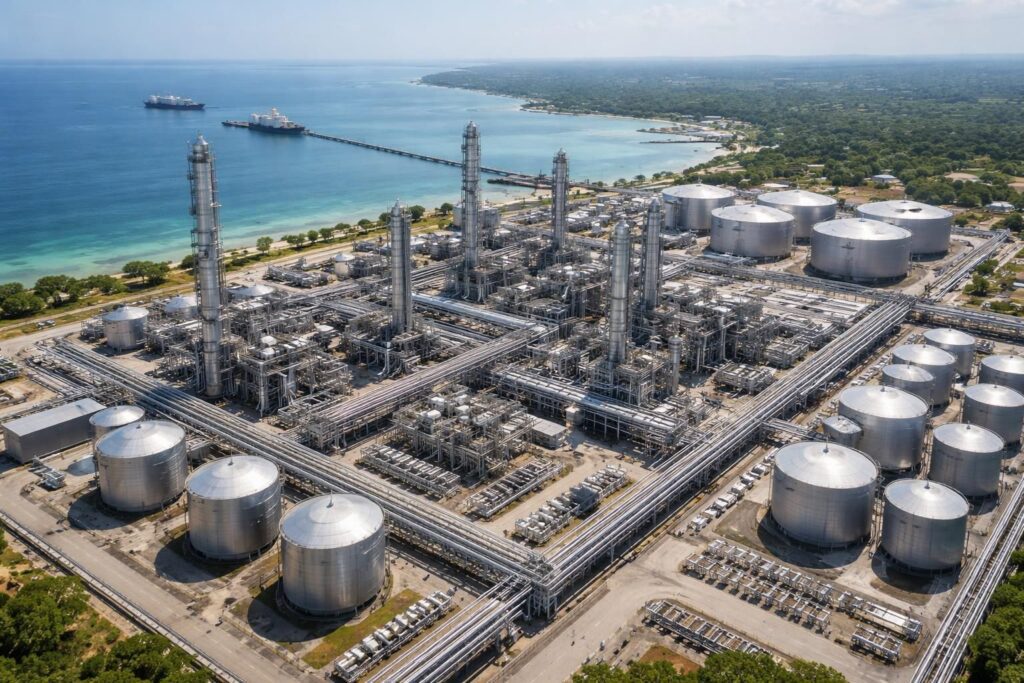
East Africa Tanga refinery plan has moved into regional debate after Kenya, Tanzania and neighbouring countries began discussing a joint refinery at Tanzania’s Tanga port. The plan matters now because East Africa imports refined petroleum products and has just faced a painful fuel-price shock.
Kenyan President William Ruto said East African countries were discussing a joint refinery in Tanga that could process crude linked to the Democratic Republic of Congo, Kenya, South Sudan and Uganda. The proposal was raised at an infrastructure financing conference in Nairobi.
Aliko Dangote said he could replicate his Nigerian refinery model in East Africa if regional governments supported the initiative. His Nigerian facility is built around a 650,000-barrel-per-day refinery, and he said a regional refinery could be delivered within four to five years if agreements are reached.
Here is what the refinery discussion means for fuel imports. East Africa currently depends on imported refined petroleum, mainly from outside the region. That leaves countries exposed when international product prices, shipping routes and supply contracts tighten at the same time.
The refinery conversation links Tanzania, Kenya, Uganda, South Sudan and DRC in one energy-security question. Uganda is also pursuing its own 60,000-barrel-per-day refinery through a separate partnership, while regional crude and pipeline projects continue to shape the wider oil map.
East Africa Tanga refinery plan: What changes for businesses and households
For businesses, the practical question is not only refinery ownership. It is whether local refining can lower supply risk, reduce payment pressure in foreign currency and improve delivery predictability for transport, manufacturing, mining, agriculture and aviation.
For households, the refinery would not change pump prices immediately. A four-to-five-year delivery horizon means current prices still depend on global supply, exchange rates, taxes, port costs and regulatory reviews. However, the plan could influence long-term expectations in fuel security.
The proposal also carries trade implications. A Tanga refining hub could strengthen Tanzania’s role in regional logistics, support port activity and create new demand for storage, pipelines, trucking, financing, engineering and maintenance services.
Friday 24th April 2026 By inAfrika Newsroom Nigeria jet fuel relief April 2026 has entered the aviation spotlight after President Bola Tinubu approved 30% debt relief for local airlines. He…
Friday 24th April 2026 By inAfrika Newsroom Kenya fuel prices April 2026 remain a top regional search issue after the energy regulator recalculated pump prices for the 16 April to…

 Swahili
  English
  French
  Portuguese
  Chinese