The history of financial power did not begin with modern European banks. Long before the nineteenth century, merchants, states and communities across Africa, Asia and the Middle East were already recording obligations, organising long-distance trade and developing ways to mobilise resources. Looking at that longer history helps explain a recurring pattern: power often belongs not only to those who possess valuable goods, but also to those who can finance production, verify transactions, connect markets and influence the rules under which others trade.
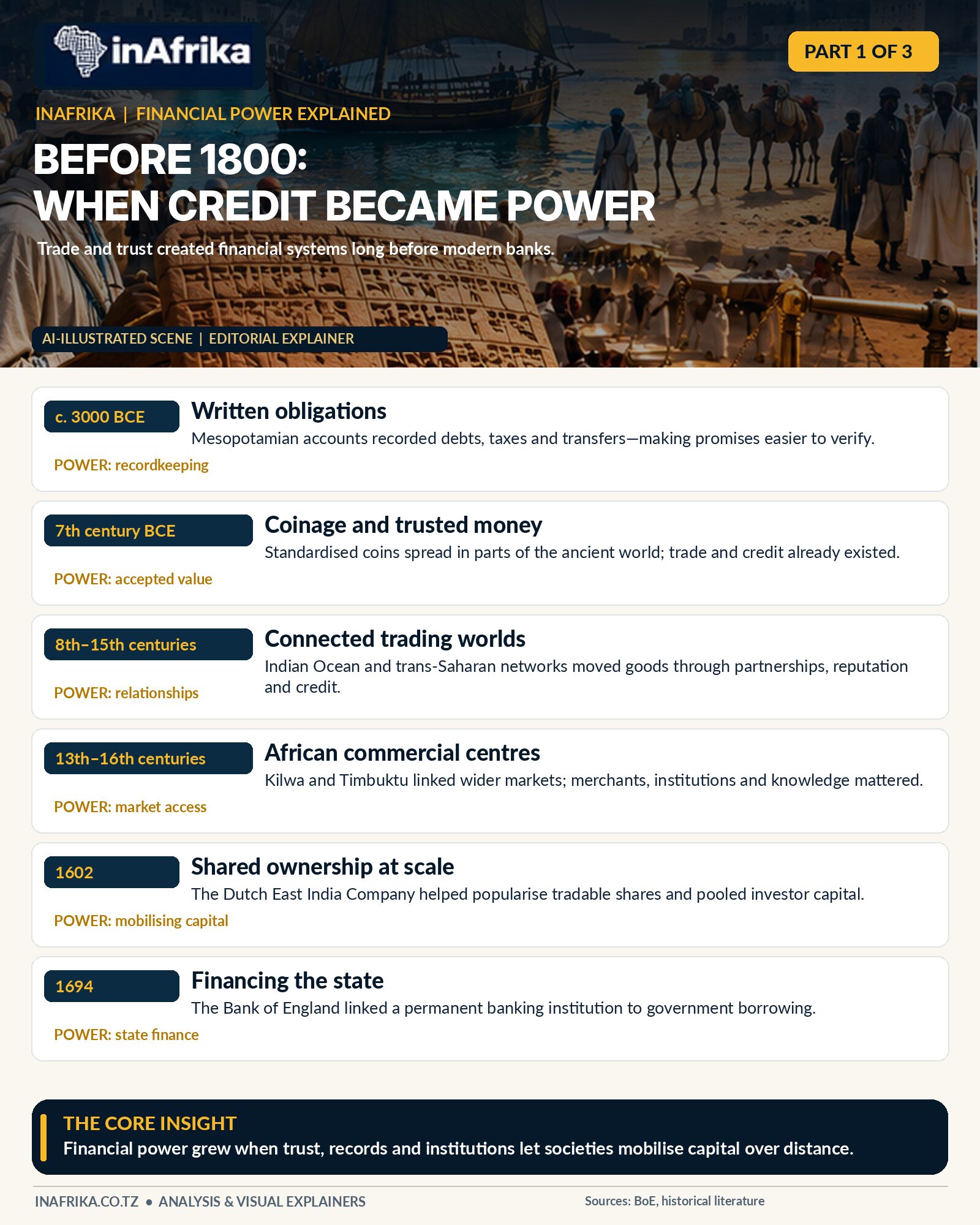
In Mesopotamia, surviving records show that credit and accounting were established features of economic activity thousands of years ago. Coins later made certain exchanges more convenient, but trade did not begin with coinage. Indian Ocean commerce and trans-Saharan routes connected suppliers, buyers, financiers and intermediaries across large distances. East African centres such as Kilwa and inland centres including Timbuktu were part of wider networks of goods, knowledge and exchange. Relationships, institutions and access to markets mattered alongside material wealth.
InAfrika illustrated explainer, Part 1: the foundations of money, credit and international trade. The artwork is an AI-generated historical interpretation, not documentary photography.
Large trading companies and state-backed financial arrangements then brought a different scale of capital mobilisation. The Dutch East India Company, chartered in 1602, became an important early example of investors pooling capital through tradable shares. The Bank of England, founded in 1694, linked institutional banking with government finance. Neither innovation was the origin of all finance; both are milestones in the growing ability to gather funds and deploy them across larger enterprises and longer periods.
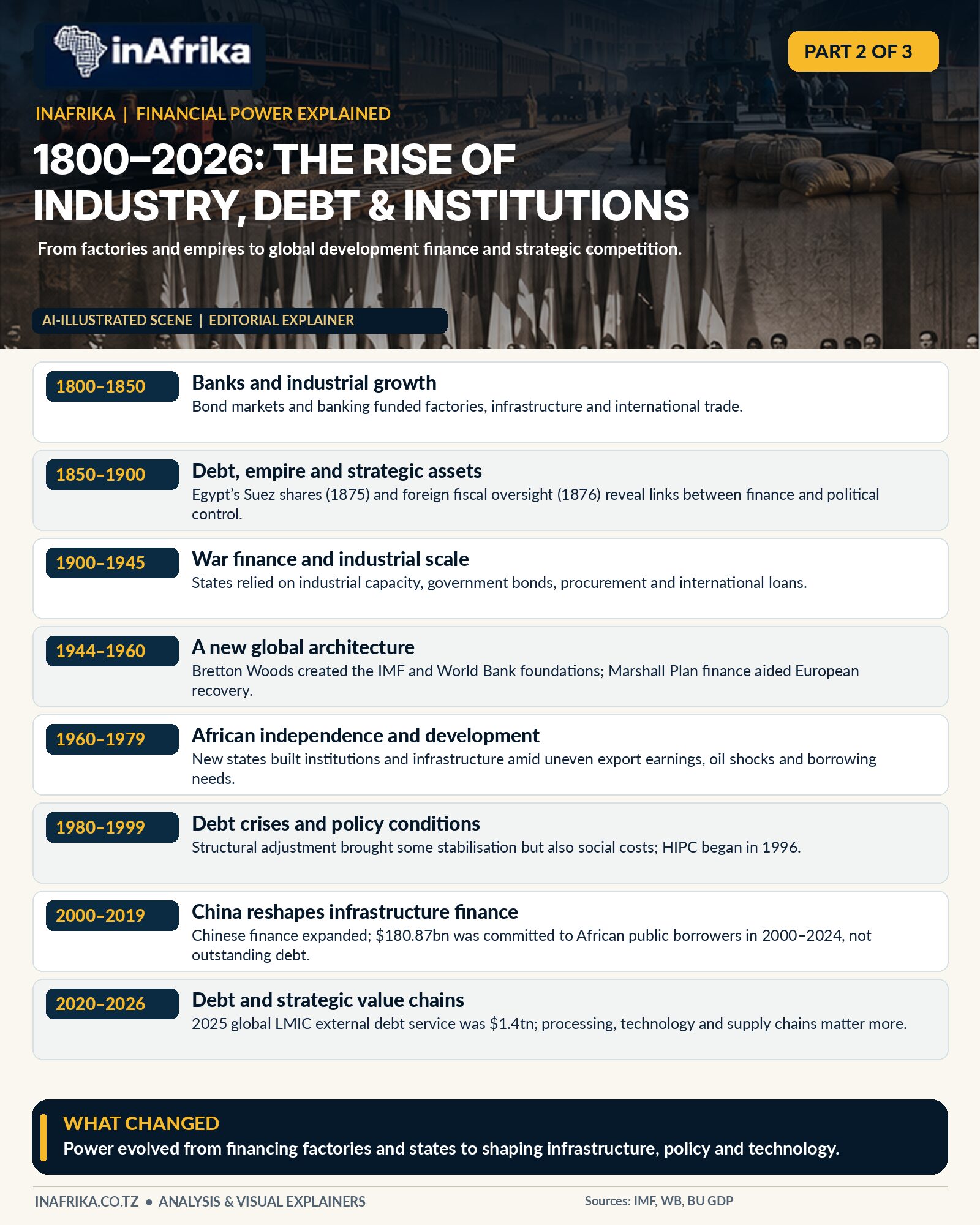
During the nineteenth century, industrialisation increased the demand for factories, machinery, railways, insurance and government borrowing. Sovereign debt, strategic infrastructure and political power could reinforce one another. Egypt’s financial difficulties and its 1875 sale of a major Suez Canal shareholding to Britain illustrate this connection. Foreign financial oversight followed in 1876, and Britain occupied Egypt in 1882. Those developments were not caused by debt alone: military strategy, imperial competition and domestic politics also played important roles.
War and industrialisation accelerated the coordination of banks, manufacturing, states and international procurement. In 1944, the Bretton Woods conference laid the foundations for the International Monetary Fund and the institution that became the World Bank. After 1948, the Marshall Plan supported European recovery while reinforcing US commercial and strategic ties. The lesson is not that international finance is automatically harmful or automatically beneficial. Financing arrangements have benefits, costs, incentives and policy consequences that must be evaluated case by case.
Part 2: the modern financial order from 1800 to 2026. AI-generated illustrative scenes accompany historically documented events.
For newly independent African states, political authority created the opportunity to set development priorities, but building infrastructure, schools, public institutions and productive industries required capital and administrative capability. Commodity-price volatility, oil shocks, external borrowing and domestic policy choices produced difficult financing conditions in many economies. Debt crises in the 1980s and 1990s led to programmes supported by the IMF and World Bank. Exchange-rate reforms, privatisation, trade opening and fiscal adjustment had varied outcomes: some addressed serious economic imbalances, while others imposed significant social costs. The Heavily Indebted Poor Countries initiative was launched in 1996 as an effort to relieve unsustainable burdens.
During the twenty-first century, China became a major investor, contractor, lender and trading partner across Africa. According to the Boston University Global Development Policy Center’s Chinese Loans to Africa Database, Chinese lenders signed approximately $180.87 billion in loan commitments to African governments and regional institutions between 2000 and 2024. That is a cumulative commitment figure. It is not the amount currently outstanding, the amount disbursed or a measure of repayments. The database also reports that new annual commitments had declined significantly from their earlier peaks, reflecting changes in financing approaches and risk appetite.
The financial constraints remain substantial. The World Bank’s International Debt Report 2026 states that low- and middle-income countries around the world paid about $1.4 trillion in principal and interest on external debt in 2025. This is a global figure, not a figure for Africa. It is a reminder that the cost of capital and the currency in which borrowing is denominated can affect the room governments have to invest in health, education, power and industrial development.
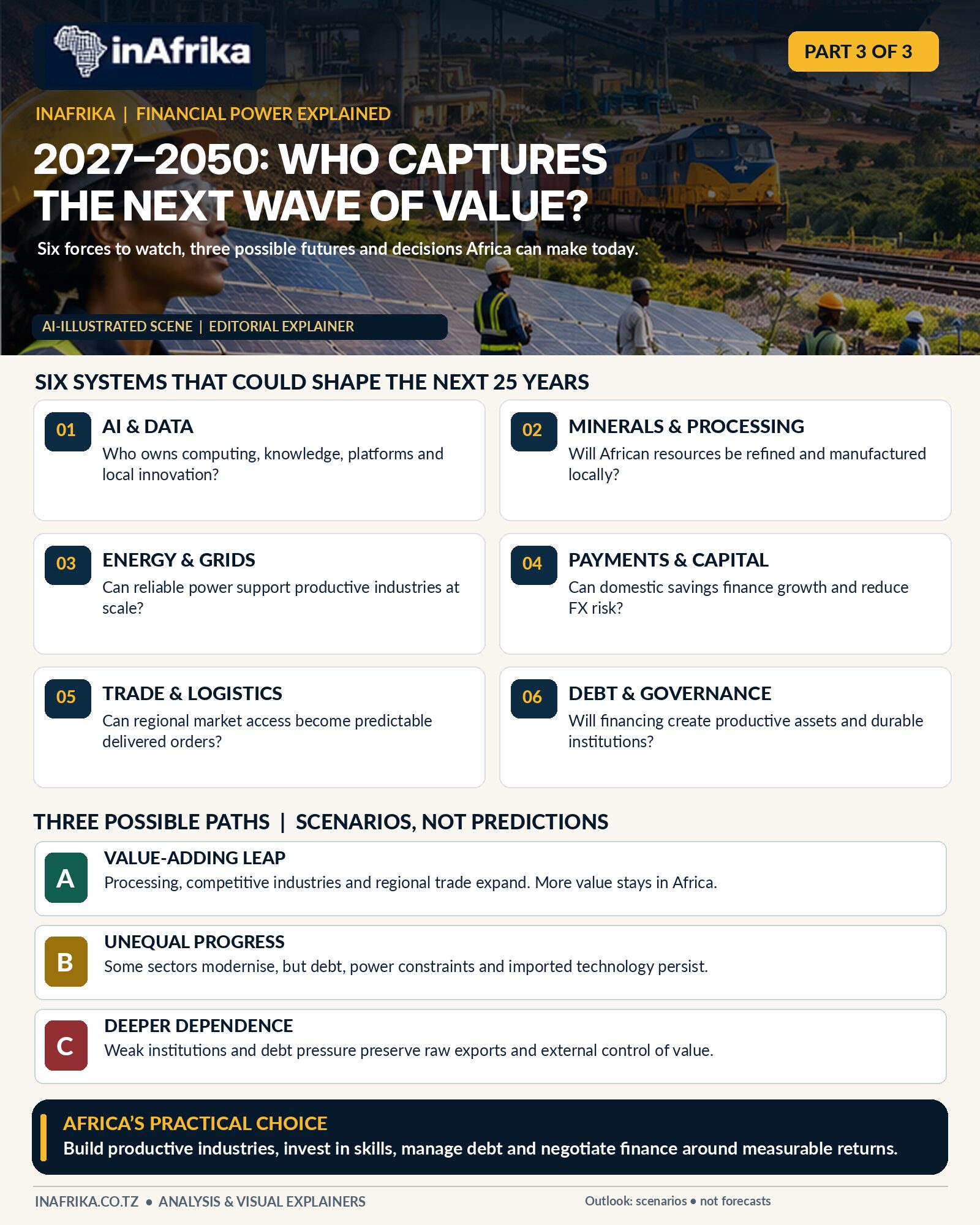
Looking ahead to 2027–2050, six interconnected questions deserve attention. Who will own and operate the computing capacity, data and systems behind artificial intelligence? Where will critical minerals be refined and turned into higher-value products? Will reliable electricity support manufacturing at scale? Can countries build deeper domestic capital markets and more efficient payment systems? Will transport and trade facilitation turn the African Continental Free Trade Area into regular commercial transactions? And will borrowing finance projects that generate durable, measurable economic returns?
Part 3: six forces and three possible pathways for Africa through 2050. These are scenarios for discussion, not predictions.
At least three broad pathways are plausible. In a value-adding transition, African firms expand local processing and manufacturing, improve logistics, build domestic financial capacity and compete more effectively in regional and international markets. In an uneven transition, progress occurs in selected industries and countries while infrastructure constraints, debt pressure and reliance on imported technology persist elsewhere. In a deeper-dependence scenario, financing costs and weak institutions limit local production and leave more value outside the continent. These are alternatives, not a forecast with assigned probabilities.
For governments, businesses and investors, the practical test is whether each investment strengthens productive capability and resilience. A port is most valuable when it supports viable trade; a mine creates broader opportunity when processing, supplier development and skills grow alongside extraction; digital payments create more value when firms can reach customers reliably; and debt is more defensible when expected benefits and repayment capacity are credible. Financial independence does not require isolation from external capital. It requires institutions and commercial strategies strong enough to negotiate relationships, retain value and diversify risk.
Lagos State is encouraging businesses to invest in manufacturing and processing as it positions itself as a commercial gateway to West African markets. State officials have pointed to transp
The Democratic Republic of Congo has urged the United States to measure progress in their strategic minerals partnership through completed investments rather than agreements alone. The messa
Tanzania and UNIDO launched their 2026–2031 industrial programme in Dodoma on 3 November, with an indicative investment framework of nearly $67 million.

 简体中文
 English
 Kiswahili
 Français
 Português