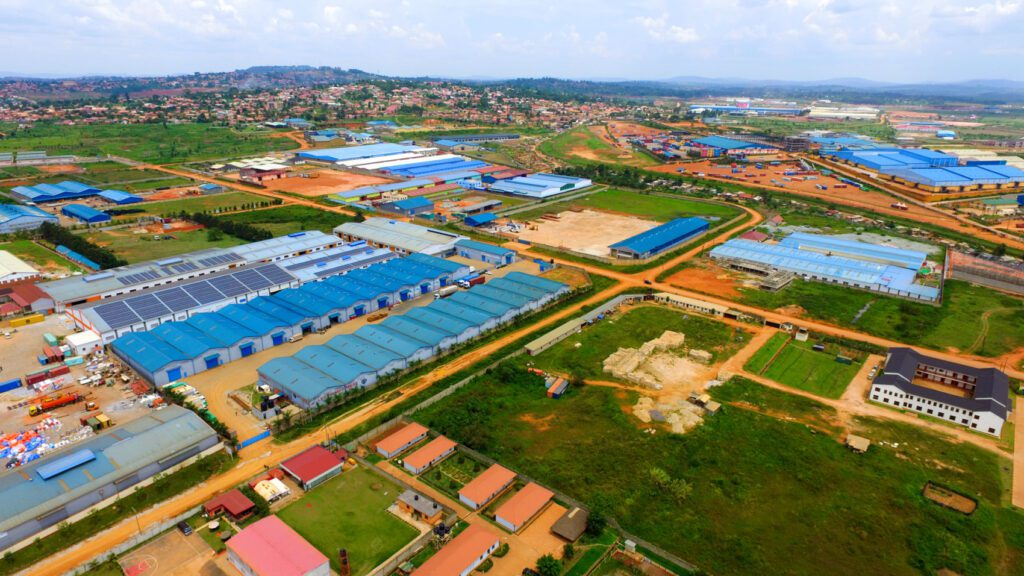
Uganda’s economy grew by about 5.8 percent in 2024, driven by agriculture, services and infrastructure. Agriculture still contributes roughly a quarter of GDP and employs more than 70 percent of the population, yet most exports leave the country with limited value addition. In this context, Uganda industrial parks are no longer just real estate projects; they are the main levers for turning dispersed agro potential into bankable industrial clusters.
Government policy recognises this. Under the Agro-Industrialisation Programme and the Fourth National Development Plan, Uganda aims to raise agricultural growth to 6 percent, cut subsistence households sharply and push more production through processing and formal markets. The industrial park programme is the physical expression of that shift.
The scale of the park opportunity
Uganda Investment Authority was originally tasked to develop around 22 industrial and business parks across the country, providing serviced land for investors and anchoring new industrial centres beyond Kampala. Today, eight public parks—such as Namanve, Jinja and Soroti—are operational, alongside at least three private parks including Liao Shen in Kapeeka and Tian Tang in Mukono.
Recent data show how quickly these sites are filling. By the end of the 2023/24 financial year, over 625 companies had been allocated land across Uganda’s public industrial and agribusiness parks. Of these, 294 were fully operational, 194 were still under construction and 139 were preparing to build. Combined, the parks have created about 122,000 direct and indirect jobs, with nearly 20,000 added in the last year alone.
At the same time, the Uganda Development Corporation has taken equity stakes in multiple agro-processing projects, from sugar and starch to edible oils and dairy, as part of the agro-industrialisation drive. This combination of parks and state-backed anchor investments signals a deliberate attempt to build full value chains in-country.
However, the system is still incomplete. Several parks face delays in infrastructure delivery, especially reliable power, water and internal roads. Some agro-industrial projects have struggled with inconsistent raw material supply and weak linkages to outgrowers. Therefore, the core question for Uganda industrial parks is how to shift from land allocation and ribbon-cutting to disciplined cluster performance.
Where Uganda can create real industrial clusters
The strongest park propositions are those that align clearly with Uganda’s comparative advantages. For agro-processing, that means parks located in surplus production belts with good road access—such as Soroti for grains and fruits, Mbale for coffee and cereals, and Namanve for integrated food and beverage processing. In these locations, industrial users can draw on nearby farmers while still reaching domestic and regional markets efficiently.
Moreover, regional integration matters. Uganda sits at the heart of the EAC and COMESA markets, with growing demand in eastern DRC and South Sudan. Parks that integrate dry ports, cold chain facilities and logistics services can, therefore, position tenants to serve these markets competitively. In practice, this means planning for logistics platforms, weighbridges and customs services alongside factory sheds, not as afterthoughts.
Energy is another differentiator. Parks that secure stable grid connections, on-site substations and space for captive solar or hybrid systems will attract heavier manufacturers and reduce operational risk. This also opens doors to climate finance, as efficient, low-emission industrial parks fit well with green investment mandates.
Finally, skills and services need to cluster with factories. Partnerships between park developers, local universities and technical institutes can create training centres inside or adjacent to parks, matching curricula to actual investor needs. In addition, shared services such as quality labs, packaging centres and repair workshops can lower entry barriers for smaller firms.
What banks, government and partners should prioritise
For banks and institutional investors, Uganda industrial parks represent a pipeline of long-term clients in one place. Instead of chasing scattered businesses, lenders can build tailored products for park tenants: medium-term loans for machinery, warehouse financing, receivables finance against regional buyers and working-capital lines linked to seasonal raw material needs. Therefore, mapping park tenants and their value chains should become part of standard corporate and SME strategy.
Government’s immediate task is to complete and maintain core infrastructure inside and around parks. That means prioritising budget and coordination for power, water, roads and digital connectivity, and resolving land-title issues quickly. Clear service-level agreements between UIA, utilities and tenants can improve trust and reduce disputes. In addition, aligning park development with the Agro-Industrialisation Programme and NDP IV targets will help avoid scattered, underutilised sites.
Development partners and DFIs can help move from project-by-project support to portfolio thinking. Blended finance facilities that co-fund common park infrastructure, de-risk long-tenor loans for anchor tenants or back value-chain finance into smallholder suppliers will crowd in private capital. Moreover, technical assistance should focus on park governance, environmental and social standards, and export-readiness support for tenant firms.
Ultimately, the test is whether Uganda industrial parks become genuine production ecosystems rather than just industrial real estate. If they do, they can convert agricultural surpluses into higher-value exports, create more stable manufacturing jobs and give banks a deeper pipeline of investable clients. For senior leaders, the opportunity is clear: disciplined execution in the parks programme can turn Uganda’s agro strength into a durable industrial base for the next development phase.
Wednesday 3rd December 2025 by inAfrika Newsroom Ghana critical minerals value chain is rapidly becoming a test case for how African countries handle the energy transition boom. Long known as…
Wednesday 3rd December 2025 by inAfrika Newsroom Egypt pharmaceutical manufacturing now sits at the centre of the country’s health, FX and industrial policy debates. The pharmaceutical market is worth around…
Wednesday 3rd December 2025 by inAfrika Newsroom South Africa just energy transition has moved from a climate slogan to a balance-sheet issue for every major business in the country. Eskom…

 French
  English
  Swahili
  Portuguese
  Chinese