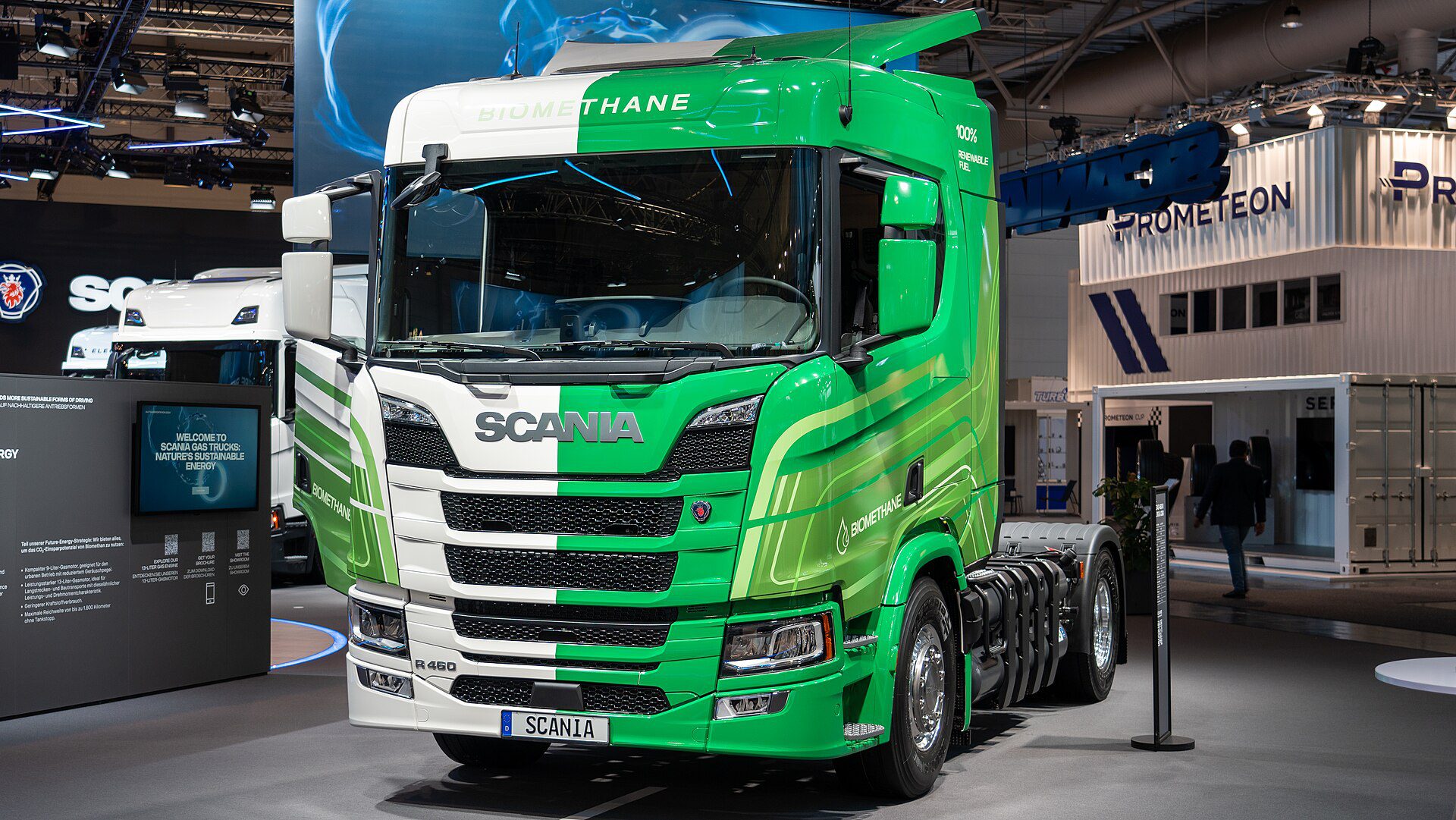
A Scania gas truck displayed at IAA Transportation in Hanover, Germany, 21 September 2024. Illustrative file photograph; it does not show the Dar es Salaam meeting or a vehicle supplied in Tanzania. The display promotes biomethane, which is distinct from fossil natural gas. Photo: MarcelX42 / Wikimedia Commons, CC BY-SA 4.0. Resized.
By inAfrika Newsroom
A Scania Tanzania discussion at the Swedish Embassy in Dar es Salaam on 30 October put refuelling access, finance and technical skills at the centre of the case for compressed natural gas in commercial transport. The meeting highlighted investment requirements, rather than announcing that a nationwide CNG refuelling network had been completed.
Scania’s public company updates confirm the CNG programme and emphasise collaboration across transport and energy businesses. Daily News’ account of the event reports calls for more filling stations, affordable financing and training for operators and technicians.
The business question extends beyond the pump price. An operator needs to compare fuel consumption on its actual routes with the cost of vehicles or approved conversions, maintenance, financing and any additional travel or waiting time involved in refuelling.
A saving observed on one demonstration route cannot establish the result for every fleet. Load, terrain, utilisation, fuel prices and access to a dependable station can change the cost per kilometre, making route-level operating records more useful than a general percentage claim.
Infrastructure investors face the other side of that calculation. A station needs sufficient regular demand to justify its equipment and operating costs, while operators need confidence that fuel will be available before committing vehicles to gas.
The environmental case also needs a defined comparison. The U.S. Department of Energy’s Alternative Fuels Data Center explains that life-cycle greenhouse-gas outcomes depend on vehicle efficiency and methane leakage upstream and at the vehicle, so a CNG switch should not be described as automatically zero-emission transport.
Renewable biomethane and fossil natural gas also have different production pathways, even though both can fuel suitable gas engines. Claims about climate benefits need to identify the fuel used and account for its supply chain, alongside any changes in local air pollutants.
Tanzania’s practical next steps are therefore specific: dependable refuelling coverage on working routes, suitable financial products and evidence of safe, reliable operation. Those conditions connect the CNG discussion to the wider effort to improve freight efficiency, where total journey cost matters more than any single input price.
Have a verified news development or story? Send news submissions and supporting materials to news@inafrika.co.tz
The proposed Kusoka solar plant would supply Sentinel copper and Enterprise nickel operations, with First Quantum still finalising its offtake agreement.

 English
 Swahili
 French
 Portuguese
 Chinese