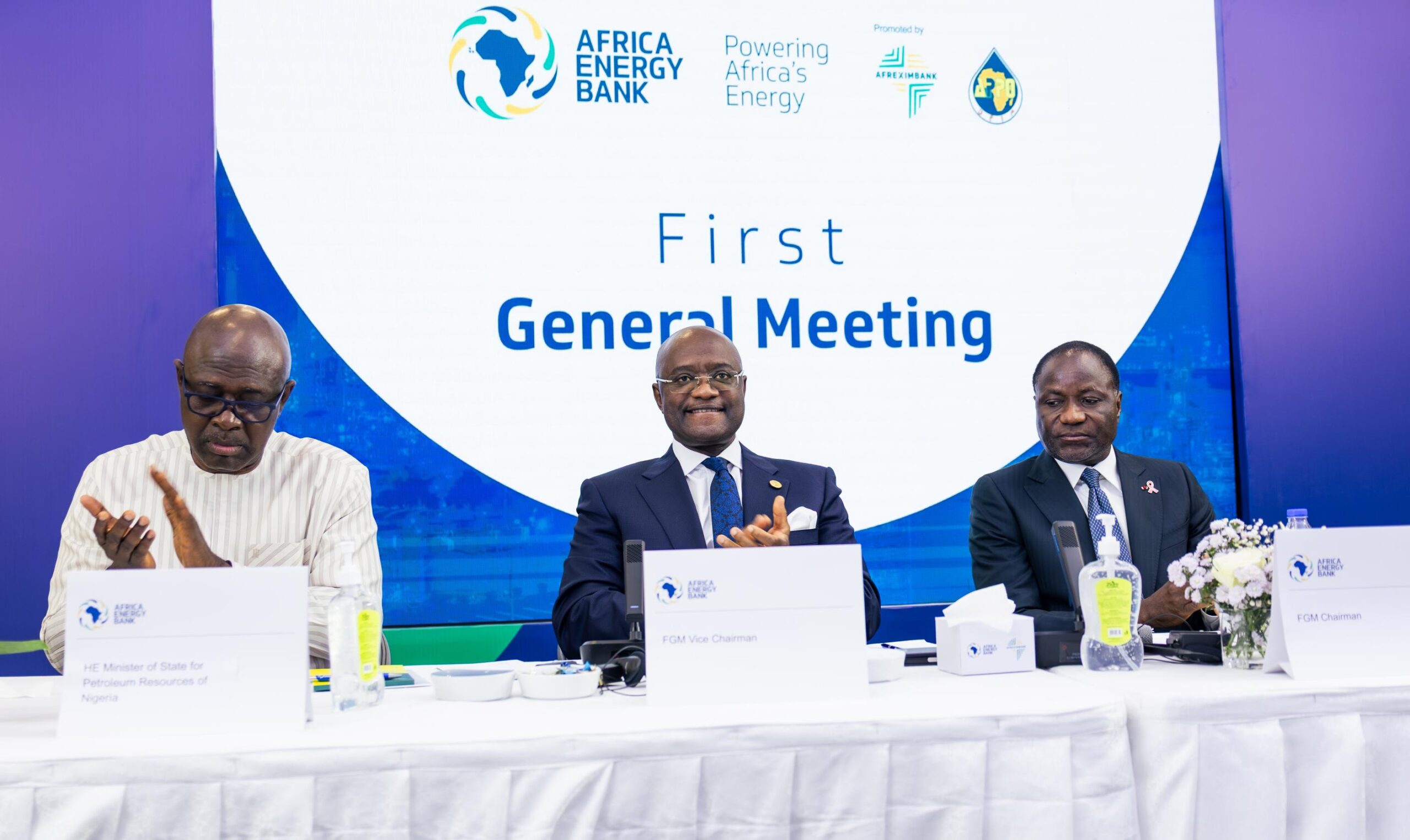
Heineken Lokpobiri, George Elombi and Mamadou Sangafowa-Coulibaly, left to right, at the first general meeting in Abuja, 31 October 2026. Photo: Afreximbank; supplied for republication.
By inAfrika Newsroom
Afreximbank and the African Petroleum Producers’ Organisation formally established the Africa Energy Bank at its inaugural general meeting in Abuja on 31 October 2026. The new institution has USD 5 billion in authorised capital, a figure that defines its capital framework rather than cash already disbursed to projects.
Their joint statement says the bank will operate as an independent supranational financial institution. The assembly appointed Helmy Ghazi as its first president and constituted a board drawn from public and private institutions.
The stated mandate spans exploration, production, transport, processing, refining and distribution. Its promoters want to attract governments, national oil companies, financial institutions and private investors, while expanding African participation in the continent’s energy businesses.
That breadth makes the institution relevant beyond extraction alone. A processing facility, pipeline or distribution network can face a different financing problem from an oilfield, even when each belongs to the same energy supply chain.
Authorised capital, subscribed capital and paid-in capital describe different stages. Authorisation permits shares to be issued within an agreed limit; subscriptions are commitments to take shares, while paid-in capital is money or other eligible value actually contributed.
Borrowing and other funding can subsequently expand a bank’s lending capacity. None of those stages should be confused with a loan approval, a signed financing agreement or a disbursement to a construction contractor.
The announcement therefore creates an institution to follow, rather than establishing that a particular African project is now funded. Developers will still need to demonstrate technical feasibility, repayment capacity, safeguards and a viable market when seeking finance.
Businesses in Tanzania and other importing economies should watch the terms and destinations of eventual transactions. Refining or distribution investments could affect energy supply chains, but the practical effects depend on completed infrastructure, reliable operations and commercial arrangements across borders.
As with other African financing mechanisms, the next useful evidence will be transaction-level detail. Published capital contributions, lending criteria and signed project agreements would make it possible to assess how the new bank’s institutional mandate translates into operating capacity.
Have a verified news development or story? Send news submissions and supporting materials to news@inafrika.co.tz
The Mtumba opening brings renewed attention to an established dealer-owned model, with practical questions about investment, operations and commercial terms.
NMB’s September accounts show TZS 634.6bn in group profit and a larger lending book, while rising impairment charges underline the need to assess credit quality.
CCAK says Kenya’s Clean Cooking Week has moved from November to 9–11 December in Nyeri. Conflicting website dates make organiser confirmation important.

 Portuguese
 English
 Swahili
 French
 Chinese